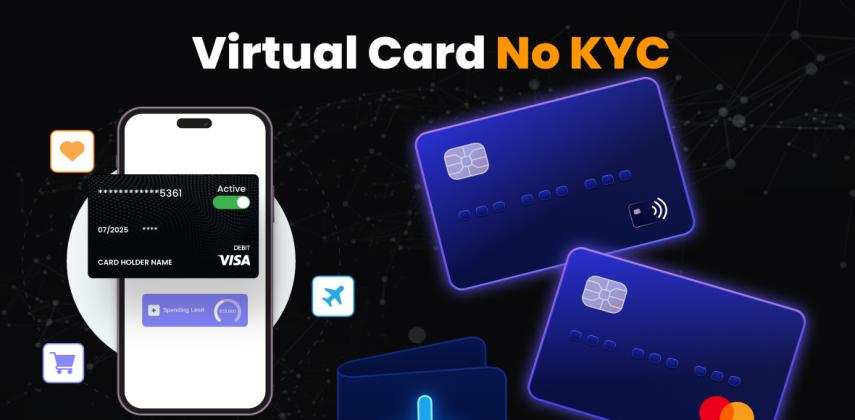
If you have spent hours searching for a virtual card no KYC that actually works, you have probably noticed the same pattern: most providers either ask for full identity documents at the next step, or they advertise no KYC virtual card products but block your card the moment you try to spend over $50.
We are going to be honest about what is and is not possible in 2026. The regulatory landscape changed significantly in the EU, US, and parts of Asia between 2024 and 2026 — particularly with MiCA's full enforcement deadline of July 1, 2026, and the EU Travel Rule that took effect December 30, 2024. Many providers that previously offered fully anonymous cards have either shut down, added verification, or moved entirely offshore.
Here is what still genuinely works: a virtual crypto card no KYC issued by a regulated bank partner that uses tiered verification — meaning small balances and transactions stay anonymous, while larger amounts may trigger additional checks. This is exactly what we built Vizovcc to deliver. Our cards are issued in under 5 minutes with email only, funded by cryptocurrency, and accepted globally across Visa and Mastercard networks. Whether you need a virtual credit card no KYC for subscriptions, a virtual debit card no KYC for ad spend, or a virtual visa card no KYC for crypto-funded online shopping, the workflow is the same.
This guide covers exactly what works, what has limits, and what no provider can legally promise in 2026.
Best Virtual Credit Card Without KYC- Seamless Transactions!
👉 Issued by - USA Bank
👉 Card Status - Reloadable
👉 Validity - 2 years
👉 Card Preloaded Fund - 190$
👉 Card Issue charge - 10$
👉 Card Work from - All Countries
👉 Used - USA from Anywhere
👉 KYC required - No
👉 Suitable For - Any kind of domestic or international transactions. 👉 Citizens from all countries can use it!
👉 Type: 3Ds Visa Card
👉 Card Status: Reloadable
👉 Validity: 3 years
👉 Card Preloaded Fund: $285
👉 Card Issue charge: $15 fee
👉 Card Work from: All Countries
👉 Bin: Universal Bin card works for all major merchants
👉 Type: 3Ds Mastercard
👉 Issued from: USA Bank
👉 Card Status: Reloadable
👉 Validity: 1 year
👉 Card Preloaded Fund: $95
👉 Card Issue charge: $5 fee
👉 Card Work from: All Countries
👉 Bin: Universal Bin card works for all countries
👉 Features: Borderless!
What "No KYC" Actually Means in 2026
The term "no KYC" gets used loosely. Different providers mean different things. Here is the honest breakdown of what each level looks like:
Tier 1 — True anonymous (rare and shrinking). No email, no phone, no account history. Pay with crypto, get card details, that is the entire interaction. These exist only on a small number of offshore providers and typically come with very low spending caps ($50–$200 lifetime), short validity (1–6 months), and high failure rates at major merchants because the BINs are flagged.
Tier 2 — Email-only signup, no ID documents (what we offer). You create an account with just an email address. No passport, no national ID, no proof of address, no selfie verification. Fund the card with crypto, get card details immediately. Spending caps and reload limits exist but are realistic for normal use ($100–$5,000+ per card depending on variant). When most users search for a no KYC virtual card or a virtual prepaid card no KYC in 2026, this is the realistic version that actually works at major merchants.
Tier 3 — Light KYC (most "no KYC" providers actually fall here). You sign up with email and phone number, sometimes a name. No documents required for basic use, but ID may be requested at higher tiers. Often advertised as "no KYC" because no documents are checked initially.
Tier 4 — Full KYC. Standard fintech onboarding with passport, address proof, sometimes video verification. Most major providers like Revolut, Wise, and Coinbase fall here.
Vizovcc operates at Tier 2. We are honest about this because being clear matters more than marketing. You sign up with an email, you fund with crypto, you get a working card in minutes — but for spending volumes above certain thresholds, additional verification may apply. Most users never hit those thresholds.
What Actually Works in 2026 - The Honest Hierarchy
We see success rates daily across thousands of customer transactions. Here is the truth about which use cases work without verification and which run into limits.
Tier 1 — Works without any additional verification
Online subscriptions under $30/month (Netflix, Spotify, YouTube Premium, Disney+, Apple subscriptions)
VPN purchases (NordVPN, ExpressVPN, ProtonVPN, Surfshark)
SaaS tools (Adobe, Notion, ChatGPT Plus, Claude Pro, Grammarly, Canva)
Gaming subscriptions (Steam, PlayStation Plus, Xbox Game Pass)
E-commerce purchases under $500 (Amazon, AliExpress, eBay, regional platforms)
Music streaming (Spotify, Apple Music, YouTube Music)
Domain and hosting (Namecheap, GoDaddy, AWS small purchases, DigitalOcean droplets)
Web3 and crypto exchange deposits (where the exchange accepts card top-up)
Tier 2 — Works, but worth knowing the caveats
Meta Ads and Google Ads campaigns. Card works for most accounts, but ad platforms run their own fraud checks that occasionally flag prepaid cards. Success rate is high but not 100%.
Apple Pay and Google Pay wallet linking. Works for most users, but Apple's anti-fraud filters can reject prepaid cards at the wallet-add step. Try linking from a stable IP without a VPN if you encounter issues.
Subscription renewals on platforms with strict regional rules (YouTube Premium country-specific tiers, certain banking-partner subscriptions). These usually need a local-BIN card rather than a generic no-KYC card — see our country-specific card posts.
Cloud services with high spending limits (AWS, Google Cloud, Azure beyond $500/month). These platforms increasingly require verified payment methods for higher-tier accounts.
Tier 3 — Will not work or will trigger verification
Banking app account funding: Linking a no-KYC card to a Revolut, N26, or traditional bank account triggers their KYC requirement on the source.
PayPal account verification: PayPal will request additional documentation if you try to use a no-KYC card to verify a PayPal account.
Large single transactions over $5,000: This crosses thresholds where most regulated networks require additional verification on the cardholder.
Crypto-to-fiat off-ramping at scale: No-KYC cards are designed for spending. Cashing out crypto via card to fiat in large amounts triggers AML reporting under the EU Travel Rule and equivalent US rules.
How the Regulation Actually Works in 2026
If you are choosing a no-KYC card in 2026, you should understand the regulatory environment because it directly affects which providers survive and which disappear overnight.
European Union — MiCA full enforcement July 1, 2026. The Markets in Crypto-Assets regulation reaches its absolute deadline on July 1, 2026 (Source: ESMA, 2026; Cyfrin, 2025). After this date, any crypto-asset service provider operating in the EU without a MiCA license becomes illegal. The EU Travel Rule, in effect since December 30, 2024, requires sender and receiver information for crypto transfers. Small low-value prepaid cards under €150 retain limited exemptions for anonymity.
United States — FinCEN regulation. The Financial Crimes Enforcement Network regulates prepaid cards, and most US-issued cards require identity verification. True no-KYC cards from US-based issuers are essentially nonexistent. Users requiring no-KYC access typically rely on offshore providers — including platforms like Vizovcc that operate under non-US bank partnerships.
United Kingdom and parts of Asia. Generally aligned with EU and US standards, with similar verification requirements. Some Southeast Asian jurisdictions including the Philippines maintain more flexible prepaid card rules.
Latin America. Mexico, Argentina, and Brazil allow low-value prepaid cards without full identity checks. This is one reason providers offering Argentine-BIN and Mexican-BIN no-KYC cards have grown faster than equivalent EU offerings.
Russia, Iran, and sanctions-affected regions. Local banking restrictions push users toward offshore no-KYC providers, but cardholders should be aware that international networks (Visa, Mastercard) have their own sanctions compliance that operates independently of the issuing bank's KYC policy.
What this means for you: Any provider claiming "fully anonymous, unlimited spending, no questions ever" in 2026 is either operating illegally, lying about their actual practices, or about to disappear. Realistic no-KYC cards in 2026 use tiered verification — anonymous at low volumes, additional checks at higher thresholds. We work within this model honestly.
Our No-KYC Virtual Card Lineup
We issue three main virtual card variants for users prioritising privacy and instant access. Whether you are looking for a virtual visa card no KYC, a virtual debit card no KYC for everyday spending, or a no KYC virtual crypto card for online subscriptions — all three options below are issued via a regulated US bank partnership, all three are reloadable, all three require zero ID verification at signup. This is what a virtual debit card no KYC 2026 setup looks like in practice when delivered through a real bank partnership rather than an unregulated offshore processor.
| Card |
Validity |
Preloaded Fund |
Issuance Fee |
Best For |
| Virtual Visa Gold |
2 years |
$190 |
$10 |
Mid-volume monthly subscriptions, freelancer tools, mid-sized purchases |
| Virtual Visa Platinum (3DS) |
3 years |
$285 |
$15 |
Long-term reload card, larger ad campaigns, multi-platform subscriptions |
| Mastercard Reloadable Classic (3DS) |
1 year |
$95 |
$5 |
Quick start, smaller purchases, single-purpose subscription cards |
All cards are universal-BIN, meaning they work across most major merchants globally without geographic restrictions. None require KYC. All are funded with cryptocurrency.
Is There a Free Virtual Card No KYC?
This is one of the most-searched variations of the keyword, and the honest answer matters: a free virtual card no KYC with real Visa or Mastercard rails does not exist in 2026 from any legitimate provider. The card networks themselves charge issuance and processing fees that no regulated bank partnership can absorb to zero.
What you will find when searching for "free crypto virtual card no KYC":
Truly free offerings with extremely low caps ($20–$50 lifetime), short validity (30–90 days), and BINs that get blocked by major merchants because they are flagged as high-risk
"Free" sign-up with hidden top-up fees of 5–10% that effectively make the card more expensive than transparent paid alternatives
Promotional offers from regulated providers giving the first card free with a minimum deposit (this is what most legitimate "free" claims actually mean)
Vizovcc charges a transparent $5 issuance fee on our entry-level Mastercard Reloadable Classic — preloaded with $95 in usable balance, so the card pays for itself the moment you use it. That is the cheapest legitimate crypto-funded virtual card no KYC option we know of in the regulated space. If you find genuinely free with high caps and major merchant acceptance, it is almost certainly an unregulated offshore service that may not exist next month.
When you check out on Netflix, Steam, or Adobe with one of our cards, the merchant's payment processor reads your 16-digit card number, expiry, and CVV. Visa or Mastercard's network verifies the card is active and has sufficient balance, runs 3D Secure 2.0 authentication for the transaction, and confirms approval back to the merchant.
At no point does the merchant see your name, your email, your wallet address, or your funding source. The card behaves identically to a regular debit or credit card from the merchant's perspective. The "no KYC" aspect lives entirely on the issuing side — between you and us — not at the merchant level.
This is why the cards work at the vast majority of online merchants. They are real Visa and Mastercard cards on real networks, just issued under a tiered verification model rather than a full-KYC model.
How to Get Your No-KYC Virtual Card in Under 5 Minutes
Step 1 — Sign up (30 seconds)
Go to getvizovcc.com, enter your email, set a password. No documents, no phone number, no identity verification required.
Step 2 — Add Funds (1–3 minutes)
Open Add Funds. Choose Bitcoin, USDT, Ethereum, USDC, Binance Pay, Litecoin, or another supported cryptocurrency. USDT on Tron typically confirms in 1–2 minutes. Bitcoin can take 10–30 minutes depending on network congestion.
Step 3 — Buy a virtual card (1 minute)
Go to the Cards section, choose Virtual Visa Gold, Visa Platinum, or Mastercard Reloadable Classic depending on your need, and complete the purchase. Card details — number, CVV, expiry — appear on your dashboard immediately.
Step 4 — Start paying
Copy your card details into any checkout that accepts Visa or Mastercard. The transaction processes immediately. No verification step at the merchant. No identity check required.
Tip: Enable 2FA in your account settings before the first transaction. Takes 60 seconds and is the single most important security step you can take with any virtual card.
Vizovcc vs Other No-KYC Card Options
| Factor |
Vizovcc No-KYC Card |
Offshore "Anonymous" Cards |
Banking-Partner Cards (Revolut, N26) |
| Identity documents required |
No |
No |
Yes |
| Email-only signup |
Yes |
Sometimes |
No |
| Funded by cryptocurrency |
Yes |
Yes |
Limited |
| Genuine bank-issued BIN |
Yes (US bank partner) |
Often unverified BIN |
Yes |
| Spending caps |
Realistic ($95–$285+ per card, reloadable) |
Often very low ($50–$200 lifetime) |
High but verified |
| Validity |
1–3 years |
Often 1–6 months |
Multi-year |
| Card succeeds at major merchants |
High success rate |
Variable, often blocked |
High success rate |
| 24/7 customer support |
Yes |
Often nonexistent |
Yes |
| Operating regulatory status |
Regulated bank partnership |
Often unregulated |
Fully regulated |
| Cost |
$5–$15 issuance + crypto deposit |
Free or very low cost |
Account fees apply |
The honest position: Fully unregulated offshore cards advertise the most privacy but come with real risks — providers vanishing overnight, BINs blacklisted by major merchants, no recovery options. Fully regulated cards offer the most reliability but require full KYC. Vizovcc occupies the middle ground: a regulated bank partnership delivering tiered verification, which means realistic privacy without the existential risks of fully unregulated offshore services.
Funding the Card with Crypto
We accept Bitcoin, Ethereum, USDT (Tron, ERC-20, BEP-20), USDC, Binance Pay, Litecoin, Dogecoin, Dash, and others. Crypto-funded virtual cards have specific advantages for privacy-focused users:
No bank account anywhere in the chain. Your crypto wallet → Vizovcc balance → card → merchant. No traditional banking infrastructure touches the transaction.
Privacy alignment. Merchants see only card details, never your funding source or wallet address.
Avoid double FX fees. Funding with USDT and spending in any currency skips one conversion layer.
Web3 compatibility. Use the card at NFT marketplaces, DeFi platforms, and crypto-native services that traditional cards struggle with.
A note on crypto privacy in 2026: The EU Travel Rule means crypto exchanges and on/off-ramps now collect sender and receiver information for transfers above certain thresholds. The privacy of your crypto deposit depends largely on where you bought the crypto in the first place. Self-custodied crypto from peer-to-peer sources retains the most privacy; exchange-bought crypto carries the exchange's KYC fingerprint.
Where Our Customers Use the Card Most
Three patterns dominate across thousands of users:
Privacy-conscious subscription management. Users who want to subscribe to streaming services, SaaS tools, and digital products without linking their main bank account to every merchant. The card acts as a privacy buffer between their finances and their digital life.
Freelancers in countries with restricted banking. Users in regions where local cards do not work internationally — Argentina, Iran, Russia, Egypt, Pakistan, and others. Our cards bypass local restrictions because they are issued under a US bank partnership.
Crypto holders spending their assets. Users with crypto balances who want to spend them at traditional merchants without first converting to fiat through a KYC'd exchange. A virtual crypto debit card no KYC like ours becomes the spend layer; their crypto wallet remains the wealth layer. This is the most common use case we see in 2026 — people holding Bitcoin or stablecoins who want to pay for Netflix, Spotify, ad campaigns, or SaaS tools without exposing their wallet to every merchant.
Security — How We Protect Every Transaction
✅ 3D Secure 2.0 authentication on every transaction (the same standard used by major banks)
✅ Unique card numbers per card — your main balance is never exposed at merchant level
✅ Real-time transaction alerts sent the moment a payment processes
✅ Custom spending limits controlled from your dashboard
✅ End-to-end encryption under PCI DSS standards
✅ Continuous fraud monitoring flagging unusual patterns 24/7
✅ Biometric authentication supported on Apple Pay, Google Pay, Samsung Pay
✅ No personal data shared — merchants see only card details, never your account information
Honest Limitations — Where Our No-KYC Card Does Not Help
We will not pretend our card solves every problem.
You need ATM cash withdrawals: Our virtual card is designed for online and digital payments only. Order our physical card option if you need ATM access — note that physical cards may have different verification requirements at higher tiers.
You are processing more than $5,000/month or single transactions over $5,000: Higher volumes cross thresholds where most regulated networks request additional verification on the cardholder. This is not Vizovcc-specific — it applies industry-wide under MiCA, FinCEN, and Travel Rule requirements.
You need to verify a PayPal, Stripe, or Wise account: These platforms run their own KYC and will request documents regardless of which card you use. Our card cannot bypass third-party KYC.
You are in a sanctions-affected jurisdiction with strict cardholder rules: Visa and Mastercard networks operate sanctions compliance independently of issuing banks. We do not process transactions that violate international sanctions, regardless of card type.
You expect zero-history, fully anonymous spending forever: No legal provider in 2026 can promise this. The realistic offering is tiered verification — anonymous at normal use levels, additional checks if your activity pattern triggers AML thresholds. We are honest that this applies to us too.
You want a card with absolutely no fees ever: Our cards have a $5–$15 issuance fee and standard reload costs. No regulated bank partnership operates at zero cost end-to-end.
Available Worldwide
Our no-KYC virtual cards are available to users in 180+ countries, including the United States, United Kingdom, European Union member states, United Arab Emirates, India, Pakistan, Iran, Russia, Argentina, Brazil, Mexico, Egypt, Nigeria, Saudi Arabia, Indonesia, Vietnam, Philippines, and many others.
If you are in a country with specific banking restrictions — Iran, Russia, Myanmar, Cuba — our cards are particularly valuable because they bypass local banking limitations using a US bank partnership rather than your local financial system.
If unsure whether we cover your country, message support@getvizovcc.com before purchasing. We confirm availability within 1–4 hours.
Get Started
Your no-KYC virtual card is one transaction away. Sign up at getvizovcc.com with just an email, deposit crypto, and your card details — number, expiry, CVV — appear on your dashboard within minutes. No identity documents. No phone verification. No bank account check. Just a working card on the Visa or Mastercard network, ready to spend at any online merchant.
Support: support@getvizovcc.com | 24/7 via email, live chat, WhatsApp, and Telegram | Response time: 1–4 hours
FAQ
Is there a genuinely no KYC virtual card in 2026?
Yes, but with realistic limits. Vizovcc issues a virtual crypto card no KYC — a virtual Visa or Mastercard with email-only signup, no passport, no national ID, no selfie verification, no proof of address. Cards are funded by cryptocurrency and issued in under 5 minutes. Spending caps and reload limits exist (typically $95–$285+ per card depending on variant), and very large transactions over $5,000 may trigger additional verification under industry-wide AML rules. For normal use under those thresholds, no KYC is required.
How does no-KYC virtual card regulation work in 2026?
The regulatory landscape changed significantly between 2024–2026. The EU's MiCA regulation reaches full enforcement July 1, 2026, and the EU Travel Rule has been in effect since December 30, 2024. The EU still permits limited-use no-KYC prepaid cards under €150 thresholds. US prepaid cards under FinCEN typically require verification, so true no-KYC access usually comes from offshore providers. Latin American jurisdictions like Mexico and Argentina retain more flexible prepaid rules. Vizovcc operates under a regulated bank partnership using tiered verification.
What is the difference between no-KYC and anonymous virtual cards?
True anonymity (no email, no account, no history) is rare and shrinking in 2026 — these typically come with very low spending caps and high failure rates at major merchants. "No KYC" usually means email-only signup with no identity documents — what Vizovcc provides. Spending limits and reload caps exist, but for normal use you keep your real banking information completely separate from your online payments. Most users find this the right balance between privacy and reliability.
Can I buy a virtual visa card no KYC or virtual debit card no KYC with crypto?
Yes. The Vizovcc workflow is exactly this: sign up at getvizovcc.com with just your email, deposit Bitcoin, USDT, Ethereum, USDC, or another supported cryptocurrency, and purchase a virtual card from your dashboard. We offer both — the Virtual Visa Gold and Virtual Visa Platinum function as a virtual visa card no KYC, while the Mastercard Reloadable Classic functions as a virtual debit card no KYC. No identity documents required for any variant. Card details appear instantly. The crypto deposit replaces traditional bank verification — your funding proves the card balance without requiring you to disclose personal information.
What happens if my no-KYC virtual card transaction fails?
Most failures fall into three categories. First, the merchant requires a card with a specific country BIN (use a country-specific Vizovcc card instead). Second, the merchant runs additional anti-fraud checks that flag prepaid cards (try a different merchant or contact support). Third, the transaction exceeds your card balance (reload via crypto). Our 24/7 support team handles disputed or failed transactions through email, live chat, WhatsApp, and Telegram with typical response times of 1–4 hours.
Does Vizovcc require KYC for higher spending volumes?
For normal use — subscriptions, SaaS, e-commerce purchases under $500, single cards under $300 — no verification is requested. For very large single transactions over $5,000 or sustained high-volume spending crossing AML thresholds, additional verification may apply. This is industry-wide under MiCA, FinCEN, and Travel Rule requirements, not Vizovcc-specific. Most users never reach these thresholds. We are honest about this rather than promising unlimited anonymous spending that no legal provider can deliver in 2026.
Why are most "no-KYC crypto cards" from major providers actually KYC-required?
Major crypto card providers like Coinbase Card and Binance Card require full KYC because they are regulated financial institutions in jurisdictions (US, EU) where this is mandatory. The "no-KYC crypto card" market is filled by smaller offshore providers, including those with bank partnerships in jurisdictions with more flexible prepaid rules. Vizovcc operates in this space — a regulated bank partnership with tiered verification rather than mandatory full KYC at signup.
How long does my no-KYC virtual card last?
Validity depends on the card variant. Our Virtual Visa Gold is valid for 2 years, the Virtual Visa Platinum for 3 years, and the Mastercard Reloadable Classic for 1 year. All three are reloadable indefinitely within their validity period — you can top up with crypto whenever needed. After expiry, you simply purchase a new card variant. There is no automatic renewal that could trigger additional verification.
Is there a free virtual card no KYC available in 2026?
A genuinely free virtual card no KYC with real Visa or Mastercard rails does not exist in 2026 from any legitimate provider. Card networks themselves charge issuance and processing fees that no regulated bank partnership can absorb to zero. Offerings advertised as "free crypto virtual card no KYC" usually fall into one of three categories: extremely low-cap cards ($20–$50 lifetime) that get blocked by major merchants, "free" cards with hidden 5–10% top-up fees, or promotional offers from regulated providers giving the first card free with a minimum deposit. Vizovcc's Mastercard Reloadable Classic at $5 issuance with $95 preloaded balance is the cheapest legitimate option in the regulated space.
SOURCES
EU MiCA full enforcement deadline July 1, 2026, - (ESMA, Cyfrin, Sumsub)
EU Travel Rule effective December 30, 2024 (no grace period) - (InnReg, Sumsub)
Small low-value EU prepaid cards under €150 retain limited exemptions - (EU AMLD 5/6 framework)
US prepaid cards regulated by FinCEN - (FinCEN official guidance)
AMLA (Anti-Money Laundering Authority) launching in 2026 - (InnReg)
3DS 2.0 standard used by major banks - (EMVCo specifications)
MiCA non-compliance fines up to 12.5% of turnover - (NeuralArb, Cyfrin)